
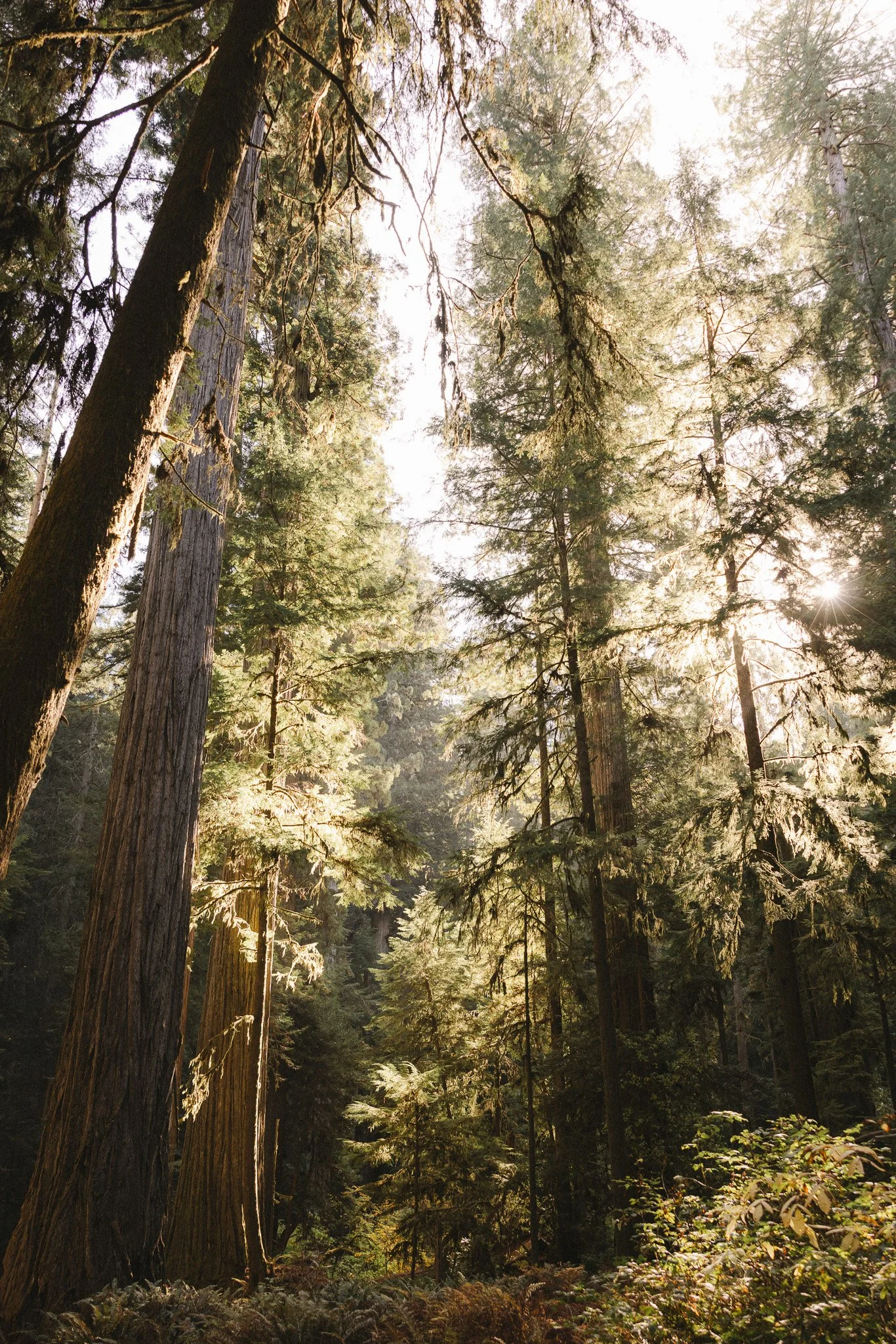
There is something completely different about standing beneath the redwoods.
You can see photographs of them and hear people describe how enormous they are, but until you’re standing at the base of one and looking hundreds of feet into the canopy, it’s difficult to understand just how incredible these forests really are.
I photograph couples throughout the redwoods here in Humboldt County, including Sequoia Park in Eureka, the Avenue of the Giants, Humboldt Redwoods State Park, and the redwood forests farther north along the Northern California coast. Over the years, I’ve learned some pretty amazing things about the trees and the forest surrounding them.
So if you’re coming to Humboldt County for your wedding, elopement, honeymoon, or photography session, here are some of my favorite things to know about the redwoods before you arrive.
1. The tallest trees on Earth are coast redwoods
The redwoods growing along the Northern California coast are coast redwoods (Sequoia sempervirens), and they are the tallest living trees on Earth.
Some grow more than 350 feet tall, and the tallest known living tree is over 380 feet tall.
That means you can stand underneath a living tree that is taller than a 30-story building.
And somehow, photographs still don’t quite communicate how enormous they feel in person.
2. Some redwoods have been alive for more than 2,000 years
One of my favorite things to think about while photographing in an old-growth forest is just how much history surrounds us.
Coast redwoods can live for more than 2,000 years.
Some of these trees were already growing during the time of the Roman Empire.
We get to walk beneath trees that have survived centuries of storms, fires, earthquakes, changing climates, and generations of people.
3. A fallen redwood can create a “fairy ring”
This might be my favorite redwood fact.
Coast redwoods have an incredible ability to reproduce by sprouting from their roots, stumps, and burls.
When an older redwood dies or falls, new redwood shoots can sometimes grow around the original tree. Over time, they can form a circle of trees commonly called a fairy ring or fairy circle.
Even more amazing: those new trees can be genetic clones of the original redwood.
So when you’re standing inside one of these circles, you may actually be surrounded by multiple trunks belonging to the same genetic individual.
It almost feels like the original tree found a way to keep living.
4. Redwoods can grow new trees from strange-looking burls
If you’ve ever noticed a big, knobby growth near the base of a redwood, you may be looking at a burl.
Burls contain dormant buds that can produce new shoots when the tree is damaged or conditions are right.
It’s one of the reasons coast redwoods are so remarkably resilient.
A tree can be injured, burned, or even cut down and still send up new growth.
5. Redwoods actually collect water from fog
Our famous Humboldt fog isn’t just beautiful in photographs. It’s part of what makes this ecosystem work.
Redwood needles can capture tiny droplets of water from coastal fog. That moisture can drip from the canopy onto the forest floor, providing additional water for the redwood and the plants living beneath it.
This process is known as fog drip.
So on one of those foggy Northern California mornings when everything is dripping even though it hasn’t been raining, the forest is essentially harvesting water from the air.
6. Their roots are surprisingly shallow
You would think a tree more than 300 feet tall would need roots extending hundreds of feet underground.
It doesn’t.
Redwood roots are generally relatively shallow, but they can spread a tremendous distance outward.
The trees gain stability partly through these broad root systems and their interactions with the surrounding forest soil and neighboring roots.
I love the contrast: some of the tallest living things on Earth aren’t anchored by one enormous taproot plunging straight down. Their strength comes from spreading outward.
7. Redwood bark can be incredibly thick
The bark of a mature coast redwood can grow many inches thick, sometimes approaching a foot in especially large trees.
It’s also rich in tannins.
That thick, fibrous bark helps insulate the living tissue inside the tree from heat, while the tannins contribute to the wood’s resistance to insects and decay.
That’s one reason you can sometimes see a redwood that has been badly scarred by fire and yet is still very much alive.
8. Some redwoods are hollow inside—and still alive
This is one you’ll notice while exploring Humboldt’s forests.
Some enormous redwoods have openings or hollow areas at their bases created by fire and other damage.
Yet when you look upward, the tree is still green.
A redwood doesn’t need every part of its trunk to remain intact to survive. As long as enough living tissue remains to transport water and nutrients, the tree can continue growing around tremendous injuries.
Some of those enormous dark openings are known as goose pens, a name that came from early settlers occasionally using hollow redwood bases as shelters for livestock.
9. There are gardens growing hundreds of feet above your head
The redwood canopy is almost another forest.
Over centuries, organic material can accumulate in large branches and crotches high above the ground, forming pockets of canopy soil.
Ferns, shrubs, mosses and other plants can grow in these miniature ecosystems hundreds of feet above the forest floor.
Scientists studying old-growth redwood canopies have discovered surprisingly complex communities living up there.
When you’re walking through the forest, you’re really only seeing the bottom layer.
There’s another world above you.
10. The haunting whistle you hear may be a varied thrush
If you’ve spent time quietly walking through our forests, you may have heard it.
A single, long, almost otherworldly whistle coming from somewhere among the trees.
One bird responsible for those beautiful forest sounds is the varied thrush.
Its song fits the redwoods almost perfectly—simple, haunting and echoing through the forest.
Once you recognize it, you’ll start noticing it.
11. Banana slugs are actually important to the forest
And then there are the banana slugs.
If you’re visiting Humboldt County, there is a very good chance you’ll meet one.
Banana slugs help break down dead plant material and fungi, returning nutrients to the forest ecosystem. They’re basically tiny, extremely slow recyclers.
They also breathe through an opening called a pneumostome on the side of their body, and they’re hermaphrodites, meaning an individual has both male and female reproductive organs.
And yes, banana slug slime has a reputation for causing a temporary numbing sensation if it contacts your tongue.
Please don’t consider that an invitation to lick one.
12. Coast redwoods and giant sequoias aren’t the same thing
Here’s an easy way to remember the difference:
Coast redwoods = tallest.
Giant sequoias = biggest by volume.
Coast redwoods thrive in the cool, foggy environment along the Northern California coast.
Giant sequoias grow naturally in specific groves on the western slopes of the Sierra Nevada.
So the enormous trees you’re seeing when you visit me here in Humboldt County are primarily coast redwoods.
13. “Redwood National Park” is a little more complicated than it sounds
There is a Redwood National Park, but the larger protected area people visit is jointly managed as Redwood National and State Parks.
It includes Redwood National Park along with Prairie Creek Redwoods State Park, Del Norte Coast Redwoods State Park, and Jedediah Smith Redwoods State Park.
And then farther south we have Humboldt Redwoods State Park, home to the Avenue of the Giants and incredible expanses of old-growth redwood forest.
So when someone says they’re “going to the redwoods,” that could mean quite a few different places.
14. Humboldt Redwoods contains one of the world’s most remarkable old-growth forests
One of the places I photograph most often is the Avenue of the Giants, which travels through Humboldt Redwoods State Park.
Within Humboldt Redwoods is Rockefeller Forest, one of the largest remaining contiguous stands of old-growth coast redwoods in the world.
There are places here where you can step away from the road, walk beneath trees that have been standing for more than a thousand years, and suddenly everything becomes incredibly quiet.
It’s one of the reasons I never get tired of photographing people here.
The redwoods are more than a beautiful backdrop
When couples travel to Humboldt County for their photographs, I want them to experience more than just a pretty location.
Look up.
Listen for the varied thrush.
Watch for banana slugs crossing the trail.
Notice the burned-out cavities in ancient trunks. Look for circles of redwoods that may have sprouted from an older tree. Pay attention to the fog collecting on the branches overhead.
You’re standing inside one of the most extraordinary forest ecosystems on Earth.
And when you realize what’s actually happening all around you, the redwoods become even more magical.
Bethany Joy Photography
Humboldt County Wedding & Elopement Photographer
Northern California Redwoods & Coast
